What Is a Transponder Key? The Complete Guide to Modern Car Security

Updated: Jun 17
Did you know that a tiny piece of technology in your pocket makes your vehicle up to 90% harder to steal? This isn't just about the metal teeth on your key. It's about the invisible digital handshake happening behind the scenes. If you've ever wondered what is a transponder key, you're holding a sophisticated anti-theft device that communicates directly with your car's computer. Without this electronic verification, your engine remains immobilized. Even if the key turns the lock, the car won't start without that specific signal.
It's frustrating to face a massive bill at the dealership or feel stranded when your key turns but the engine stays silent. We understand the confusion between a standard remote fob and a specialized transponder chip. This guide clears up the mystery of how these keys protect your vehicle and why professional programming is the only way to ensure they function correctly. You'll learn how to identify your key type and find a faster, more affordable alternative for replacements. We have a plan to help you regain access without the dealership headache.
Key Takeaways
Learn how to identify high-security keys by checking for a bulky plastic head or a specific security light on your dashboard.
Understand exactly what is a transponder key and how its internal chip uses an electromagnetic field to communicate with your vehicle.
Discover why mechanical cutting is only half the process; your key requires precise electronic programming to sync with the car's computer.
Identify the differences between a simple remote fob and a transponder chip to avoid common repair frustrations.
Explore how specialized mobile services offer a more efficient, cost-effective alternative to expensive dealership visits and towing fees.
Table of Contents
Defining the Transponder Key: More Than Just a Metal Blade
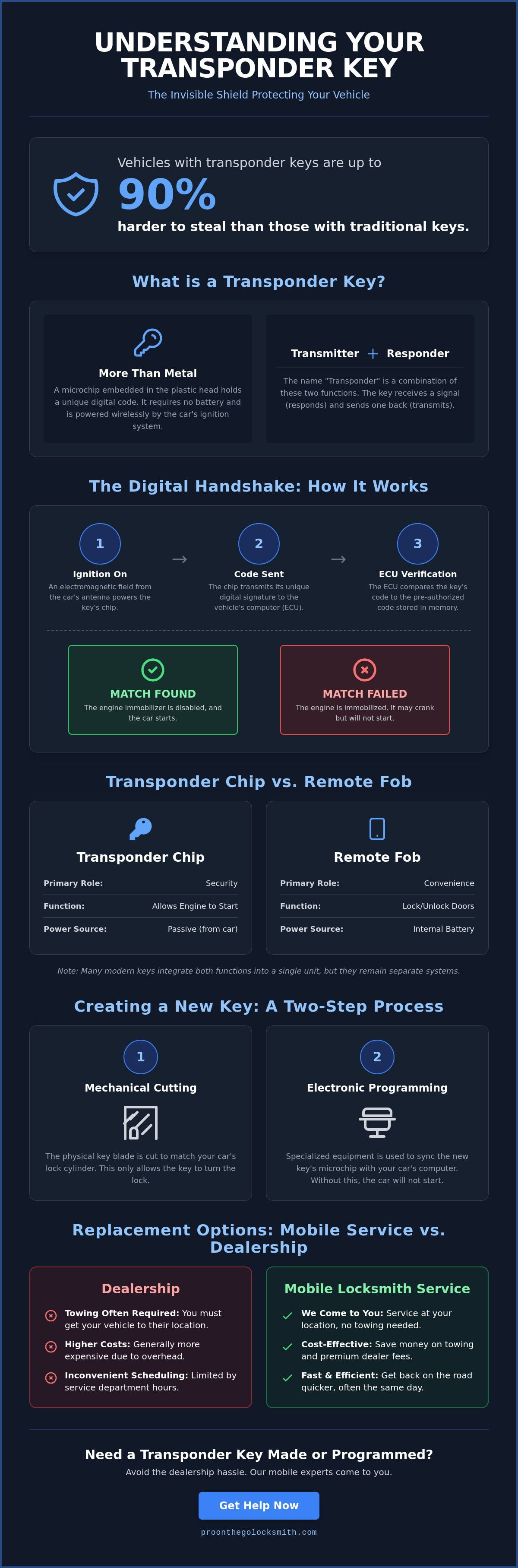
To understand what is a transponder key, you have to look past the physical metal blade. The word itself is a portmanteau of "transmitter" and "responder." While a traditional key relies solely on mechanical alignment to turn a lock cylinder, a transponder key uses a microchip embedded inside the plastic head to provide a second layer of security. This chip doesn't require an internal battery. Instead, it's powered by a small electromagnetic field generated by the car's ignition system when the key is inserted. It's a passive device that waits for the car to "wake it up" before sending its unique code back to the vehicle's computer.
Before the mid-1990s, car keys were simple flat metal tools. Anyone with a basic knowledge of ignition wiring could "hot-wire" a vehicle by bypassing the lock. Transponder keys changed this dynamic by introducing a digital handshake. If the vehicle's computer doesn't receive the correct signal from the chip, the fuel system or ignition remains disabled. It's the difference between having a physical key to a house and having a key that also requires a specific digital signature to unlock the front door. This technology transformed the car from a mechanical machine into a secure, electronic asset.
The History of the "Chip Key"
Car manufacturers began a widespread rollout of this technology around 1995. The primary goal was to combat a massive surge in vehicle thefts. According to industry research, vehicles equipped with these systems are up to 90% more difficult to steal than those with traditional keys. The technology has evolved significantly since its inception. Early models used "fixed codes" that were easier for sophisticated thieves to intercept. Modern systems now utilize "rolling codes" that change every time you start the car. This constant variation makes it nearly impossible for a thief to replicate the signal or use "code grabbing" devices to steal your vehicle.
Transponder vs. Key Fob: What is the Difference?
Many drivers use the terms "fob" and "transponder" interchangeably, but they serve completely different roles. A key fob is a remote device designed for convenience; it handles locking doors, opening the trunk, or sounding the panic alarm. The transponder is the security chip that communicates with the engine's immobilizer. In some modern designs, these components are integrated into a single unit. In others, they're separate pieces on the same ring. It is quite common for a key fob to stop working because of a dead battery while the transponder remains perfectly functional. This means you might have to unlock your door manually, but the car will still start because the transponder chip doesn't rely on the fob's battery to talk to your ignition.
The Digital Handshake: How a Transponder Key Works
Understanding what is a transponder key requires looking at the invisible communication between your ignition and the dashboard. Tucked behind the plastic trim of your steering column is a component called an induction coil or antenna ring. This copper loop encircles the ignition cylinder, acting as the primary communication hub. The moment you insert your key, this coil generates a low-level electromagnetic field. This field serves a dual purpose: it provides the wireless power needed to wake up the microchip and creates a path for data transmission.
Once powered, the chip transmits a unique digital signature back to the vehicle's Engine Control Unit (ECU). Think of the ECU as the car's brain. It receives this signal and instantly compares it to a pre-authorized "password" stored in its memory. If the codes match, the ECU sends a green light to the fuel injectors and the ignition system. If the handshake fails, the car stays in a locked-down state. You might hear the engine crank as the starter motor turns, but because the ECU hasn't verified the key, it withholds the fuel and spark necessary for the engine to fire. This diagnostic symptom is often the first sign that your key's chip is damaged or desynchronized.
RFID Technology in Your Pocket
The core of this system is Radio Frequency Identification, or RFID. You can learn more about how RFID technology works to see how these signals move through the air. For security reasons, the range of this signal is extremely short, typically limited to just a few inches. This prevents someone from "sniffing" your key's code from a distance. Because the system uses passive RFID, the chip inside the key doesn't need its own battery; it simply harvests energy from the induction coil's field to perform its task. If you're experiencing a failed handshake, you may need professional transponder key programming to resync the components.
The Immobilizer System: Your Car’s Silent Guard
The immobilizer is the software-driven shield that acts on the ECU's orders. By cutting off the fuel pump or the starter relay, it makes traditional hot-wiring methods completely ineffective. You can usually monitor the status of this system via a security light on your dashboard. In a healthy system, this light typically flashes while the car is off and disappears once a valid key is recognized. If the light stays solid or flashes rapidly while you're trying to start the car, the immobilizer has rejected the key. This clear visual signal tells you that the mechanical cut of the key is correct, but the electronic verification has failed.
How to Tell if You Have a Transponder Key
Determining what is a transponder key in your specific case often begins with a simple visual inspection. While older vehicles used flat, thin metal keys, modern security requirements have made keys much bulkier. If the head of your key is encased in thick plastic or rubber, it likely houses a microchip. However, a plastic head alone isn't a guarantee. Some older vehicles used plastic covers for grip without any internal electronics. As a general rule, if your vehicle was manufactured after 1998, there is a very high probability that it utilizes transponder technology for theft prevention.
If you want a definitive answer without using specialized tools, you can perform the "Aluminum Foil Test." Wrap the plastic head of your key tightly in three or four layers of heavy-duty aluminum foil, ensuring the metal blade is still exposed. Attempt to start your car. The foil acts as a shield, blocking the RFID signal from reaching the induction coil. If the engine cranks but won't fire, or if it starts and immediately stalls, you've confirmed that a chip is present. This simple DIY diagnostic confirms that the mechanical cut is correct, but the digital handshake is being blocked.
Common Visual Indicators
Manufacturers often leave subtle clues on the hardware itself. For example, Toyota and Lexus keys frequently have a small "dimple" or a tiny "G" or "L" stamped into the metal blade near the plastic base. These marks signify specific chip generations. You should also look for a small, rectangular "trap door" or a different colored plastic plug on the side of the key head; this is where the chip was inserted during manufacturing. Additionally, if your key is "laser-cut" with a wavy groove running down the center of the blade rather than traditional teeth on the edges, it almost certainly contains a transponder.
The Dashboard Warning Signs
Your car's dashboard is designed to communicate the status of the immobilizer system. When you turn the ignition to the "On" position, look for a security light. This is often shaped like a small car with a padlock or a simple "Security" or "Theft" text indicator. If the light illuminates for a few seconds and then turns off, the ECU has recognized your key. A flashing security light usually indicates a programming error or a damaged chip that the car cannot verify. If the light blinks rapidly and the car won't start, the system is actively blocking the ignition because it doesn't recognize the digital signature of the key in the cylinder.
Programming vs. Cutting: Why You Can't Just "Copy" a Chip Key
If you take your car key to a local hardware store, they can easily duplicate the physical blade. The teeth will match, the key will turn in the door and the ignition will rotate. But the engine will stay silent. Cutting the metal only addresses the mechanical requirement. It does nothing for the electronic verification. To understand what is a transponder key in a functional sense, you must view it as a two-part security system. The second part is the programming: a process where a specialist syncs the unique ID of the new chip to your vehicle's Engine Control Unit (ECU).
Many retail chains attempt to bypass this by using "cloning" machines. These devices try to copy the digital ID of your working key onto a generic chip. While this might work for some older models, it often fails on modern vehicles. A cloned key is essentially a digital twin, which can confuse the vehicle's security system. A professional transponder key programming service performs a deeper, more reliable integration. Instead of just copying an old ID, we introduce a brand-new, unique ID to the car's computer. This ensures the car recognizes the new key as an authorized, independent tool, maintaining the integrity of the rolling code system.
The Cost of Professional Equipment
Locksmiths invest heavily in specialized OBD-II scanners to "introduce" a new key to your car's brain. These tools allow us to communicate directly with the immobilizer module. Dealerships often charge a significant premium for this service, largely due to their high overhead and administrative costs. Pro On The Go Locksmith utilizes the same high-tier technology as the dealer. We provide the same precision and security verification, but we do it with the efficiency of a mobile specialist who values your time.
While digital tools are essential for modern vehicles, the art of physical security remains a core part of the locksmithing industry. To learn more about the specialized hardware used by professionals to navigate mechanical locks, check out Lockpick Pros.
Can You Program a Key Yourself?
You might have heard of the "Two-Key Method" for older Ford or GM models. If you already have two working keys, some older systems allow you to enter a sequence that "teaches" the car to accept a third key. However, this is becoming rare. Modern vehicles, especially those built after 2015, utilize sophisticated rolling code systems and software encryption. These require professional software to access. Attempting unverified DIY methods is risky. If the ECU detects multiple failed programming attempts, it may enter a "locked" state. This requires a full system reset, turning a simple key replacement into a major electronic repair. Understanding what is a transponder key means respecting the complexity of the software guarding your vehicle.
Mobile Transponder Key Services in Tampa
When you are stranded with a vehicle that won't start, knowing what is a transponder key is only half the battle. The next step is finding a resolution that doesn't involve an expensive tow truck or a long wait at a dealership. Our mobile service model eliminates these hurdles by bringing a fully equipped laboratory directly to your location. Whether your vehicle is in a suburban driveway or a crowded parking garage, we perform on-site diagnostics and programming to resolve the issue immediately. This approach bypasses the logistical nightmare of transporting a non-starting car to a service center.
Security is a primary concern when dealing with digital vehicle access. Pro On The Go Locksmith operates as a licensed Florida locksmith (#HCLOC23013), providing the professional accountability required for high-security automotive work. We handle "All Keys Lost" situations where you have no original key to copy. In these scenarios, we use specialized software to clear old keys from the car's memory and introduce new, secure transponder chips. This process restores your mobility while ensuring that any lost or stolen keys will no longer function, effectively resetting your vehicle's security perimeter.
Expert Key Fob and Transponder Programming
We specialize in transponder key programming for a wide range of vehicles, including domestic brands and sophisticated high-end imports. The technical process of syncing a new chip to your ECU typically takes between 30 and 60 minutes. This is a significant speed advantage compared to the full day often required by a dealership service department. By focusing on precision and efficiency, we get you back on the road without the unnecessary administrative delays common in large service centers. Our technicians stay updated on the latest software encryption to ensure a perfect digital handshake every time.
Emergency Assistance for Tampa Drivers
Our mobile units maintain a consistent presence throughout the region, serving areas like Downtown Tampa, Ybor City, and Brandon. We understand that a broken key can happen anywhere, which is why we also provide broken car key extraction to remove snapped blades from your ignition cylinder. Once the physical obstruction is cleared, we can immediately cut and program a replacement chip on-site. If you find yourself questioning what is a transponder key because your current one has failed, we have a plan to fix it. Contact Pro On The Go Locksmith for on-site service today!
Secure Your Vehicle with Professional Precision
Understanding what is a transponder key helps you appreciate the sophisticated technology guarding your car every day. These keys are more than just metal tools; they are electronic gatekeepers that require a precise digital handshake with your vehicle's computer to function. Whether you are identifying a chip key via the dashboard security light or testing it with the aluminum foil method, the importance of professional programming is clear. A simple cut might turn the lock, but only expert synchronization will fire the engine.
If you're facing a lockout or a lost key situation, you don't have to settle for high dealership prices or the hassle of a tow truck. Pro On The Go Locksmith specializes in all-keys-lost situations and provides full mobile on-site service across Tampa. As a Florida Licensed Locksmith (#HCLOC23013), we bring the necessary high-tier technology directly to your driveway or parking lot. We have a plan to get you back behind the wheel with speed and professional reliability.
Get Expert Transponder Key Programming in Tampa
Restoring your access shouldn't be a stressful ordeal. We are here to ensure your car's security system works for you, not against you.
Frequently Asked Questions
Will a transponder key work if the battery in my fob is dead?
Yes, your car will still start even if the key fob battery is completely drained. The transponder chip inside the key is a passive device that harvests energy from the electromagnetic field generated by the ignition's induction coil. While you may need to use the physical blade to unlock the door manually, the engine will fire once the key is in the ignition because the chip doesn't require internal battery power to communicate with the ECU.
Can I buy a blank transponder key online and have a locksmith cut it?
You can purchase a blank key online, but many locksmiths cannot guarantee the results of programming third-party hardware. Generic keys found on auction sites often contain incorrect chip frequencies or low-quality components that fail to sync with the vehicle's computer. It is generally more reliable to source the key directly from a specialist who can verify the exact hardware specifications for your specific year and model before beginning the cutting and programming process.
How much does it cost to replace a transponder key in Tampa?
The total investment for a replacement depends on your vehicle's make, model, and the complexity of the encryption. While dealerships often represent the highest cost tier due to administrative overhead, a mobile locksmith provides a more efficient alternative by performing the work on-site. This eliminates the need for a tow truck and allows for faster turnaround. For an accurate quote in the Tampa area, it is best to provide your VIN and key type to a technician.
What happens if my transponder key gets wet?
Exposure to water can permanently damage the internal microchip if moisture penetrates the plastic casing. While many modern keys are weather-resistant, a full submersion in a pool or washing machine often causes a short circuit in the RFID transmitter. If your car no longer recognizes the key after it gets wet, the chip has likely failed. In this situation, you will need a professional to program a new chip to restore your vehicle's security handshake.
Can a transponder key lose its programming over time?
It is extremely rare for a key to simply "forget" its programming, but external factors can cause desynchronization. High-voltage electrical surges, a failing car battery, or physical damage to the chip's internal antenna can lead to communication failures. If you're wondering what is a transponder key failure versus a mechanical issue, look for a flashing security light. This usually indicates that the digital data has become corrupted or the chip can no longer transmit its ID.
How long does it take to program a new transponder key?
Most transponder keys can be cut and programmed in approximately 15 to 30 minutes. The mechanical cutting of the blade takes only a few minutes, while the electronic synchronization via the OBD-II port takes a bit longer depending on the vehicle's security protocol. Some high-end European models may require additional time for software decryption, but a specialized mobile technician can typically complete the entire process in under an hour right at your location.
Do I need the original key to make a new transponder key?
You do not need the original key to generate a replacement. While having a working key makes the duplication process faster, a specialist can perform an "All Keys Lost" solution by connecting a diagnostic tool directly to the vehicle's computer. We can extract the necessary security codes from the ECU and program a brand-new set of keys from scratch. This is a standard procedure for mobile locksmiths and is far more efficient than replacing the entire ignition system.
Why is my car not recognizing my transponder key?
If your car fails to recognize the key, the issue is usually a damaged chip or a faulty induction coil in the steering column. Physical trauma, such as dropping the key on a hard surface, can crack the delicate microchip inside the plastic head. Alternatively, if the car's antenna ring is failing, it won't generate the electromagnetic field needed to power the chip. A professional diagnostic can determine if the problem lies with the key hardware or the vehicle's receiving components.