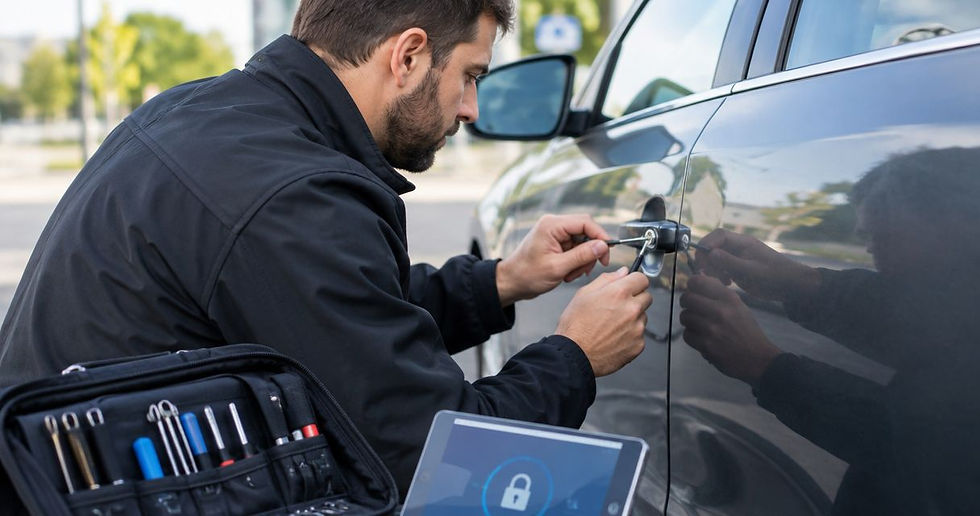
Key Broken in Car Door Lock? Professional Extraction and Recovery Guide

That sudden, metallic snap as you turn your key isn't just a minor inconvenience. It is a high-stakes mechanical failure that often leads to expensive, unnecessary repairs when handled incorrectly. We understand the immediate wave of anxiety that hits when you realize you have a key broken in car door lock while standing in your driveway or a grocery store parking lot. It's natural to feel frantic about the potential cost of a dealership visit or the fear of being stranded for hours while your schedule slips away.
A broken key in a car door lock should be assessed before deciding whether extraction, lock repair or replacement is needed. This guide explains what to avoid and what a mobile locksmith may check. On-site extraction, replacement key cutting and programming depend on the vehicle, the condition of the lock and supported service options. Ask for an assessment and estimate before authorizing work.
Key Takeaways
Stop all attempts to manipulate the lock immediately. Pushing the fragment deeper into the cylinder often turns a simple extraction into a full lock replacement.
Understand the mechanics of a key broken in car door lock, specifically how metal fatigue and cylinder misalignment create the stress points that lead to a snap.
Discover why professional extraction tools like saw-tooth extractors are necessary to remove wedged metal without scratching delicate internal wafers.
Avoid the risks of DIY methods using household items, which typically lack the tensile strength required for a successful recovery and can cause permanent hardware damage.
Ask whether mobile extraction, replacement key cutting or programming is supported for your vehicle. On-site service and any need for towing depend on the vehicle, lock condition and available service options.
Table of Contents
Key Broken in Car Door Lock: Immediate Steps to Take
Broken key extraction is the precise process of removing a snapped metal fragment from a lock cylinder without damaging the delicate internal components. It is not a brute-force task. Success depends on using specific tools to bypass the pins and grip the fragment securely. When you realize you have a key broken in car door lock, your first instinct might be to panic or attempt a quick fix. However, your immediate actions will determine whether this remains a simple service call or turns into a costly hardware replacement.
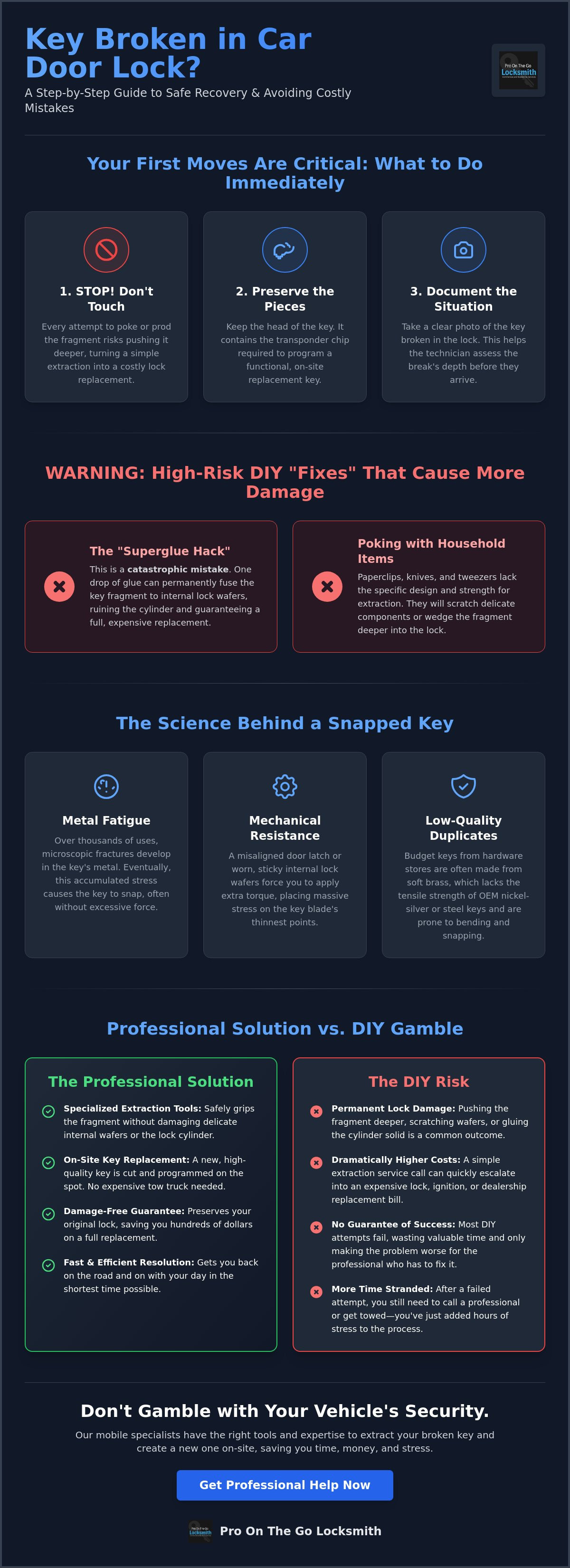
The golden rule of key extraction is simple: stop touching the lock immediately. Every attempt to poke, prod, or "hook" the fragment with a paperclip or pocketknife increases the risk of pushing the metal deeper into the cylinder. Once the fragment passes the last pin stack, it becomes significantly harder to retrieve. Follow these diagnostic steps to prepare for a professional resolution:
Check all other entry points: Determine if you are truly locked out or if you can still access the vehicle through the passenger door or trunk.
Preserve the broken pieces: Keep the "head" or bow of the key. Modern keys often contain a transponder chip that your technician will need to clone or read to provide a functional replacement.
Document the situation: Take a clear photo of the lock face. This helps your mobile technician understand the depth of the break before they arrive on-site.
Why You Should Avoid the "Superglue Hack"
Internet forums often suggest using a drop of superglue on the end of a wire or the other half of the key to pull a fragment out. This is a catastrophic mistake for modern automotive security. Because of how car door locks work, the internal tolerances are incredibly tight. A single microscopic drop of adhesive can bond the key fragment to the lock wafers permanently. Once those wafers are glued in place, the cylinder is ruined. DIY attempts can complicate extraction and may result in additional repair or replacement work. Glue residue is almost impossible to clear from precision-engineered internals without a complete teardown.
Assessing the "Snap Point"
The difficulty of your situation depends largely on where the key snapped. A flush break means the fragment is visible at the edge of the keyway, while a deep break leaves the fragment buried behind several pin stacks. Dealing with a key broken in car door lock also requires observing the orientation of the cylinder. If the key broke while you were in the middle of a turn, the cylinder might be stuck in a rotated position. A turned cylinder must be reset to its neutral, vertical position before any extraction tools can successfully engage the fragment and pull it through the keyway path.
Why Car Keys Snap: Understanding Metal Fatigue and External Factors
A key snapping inside a lock is rarely a random event. It is usually the climax of a long, silent process called metal fatigue. Every time you insert your key and apply torque, the metal undergoes microscopic stress. Over thousands of cycles, these tiny fractures accumulate. Eventually, the metal reaches its breaking point. If you find a key broken in car door lock, you are likely seeing the result of years of structural degradation rather than a single moment of excessive force.
External mechanical issues often accelerate this timeline. Misaligned lock cylinders are a frequent culprit. When a door latch or internal linkage doesn't line up perfectly, the cylinder resists turning. This forces you to apply more pressure. That extra leverage places lateral stress on the thinnest part of the key blade. Similarly, worn internal wafers can become "sticky" due to debris or lack of maintenance. When the wafers don't drop smoothly into the key's bitting, the resulting resistance encourages the user to twist harder, leading directly to a failure.
The quality of the key itself plays a critical role in its lifespan. Many "budget" duplicates found at hardware stores are cut from soft brass blanks. While brass is easy to cut, it lacks the tensile strength of original equipment manufacturer (OEM) materials like nickel-silver or hardened steel. Professional car key replacement services prioritize high-grade materials that can withstand the daily rigors of automotive use without bowing or snapping.
The Tampa Factor: Salt Air and Humidity
Living in the Tampa Bay area introduces unique environmental stressors to your vehicle's security hardware. Salt air is highly corrosive. It penetrates the lock cylinder and causes oxidation on the internal springs and wafers. High humidity further compounds the problem, as moisture trapped inside the lock can cause metal components to expand and seize. Florida drivers should avoid using oil-based lubricants like WD-40, which attract dust and eventually turn into a thick, gummy residue. Instead, use a dry graphite lubricant to keep the mechanism moving freely without attracting contaminants.
Signs Your Key is About to Break
Prevention is always more efficient than extraction. You can often spot a failing key before it leaves you stranded. Look for these warning signs:
Stress whitening: Look for faint, pale lines near the head of the key where the metal has begun to stretch.
Increased resistance: If you have to jiggle or pull the key slightly to get it to turn, the internal wafers or the key bitting are significantly worn.
A "spongy" feel: If the key feels flexible or soft when you apply pressure, the structural integrity is already compromised.
Professional Extraction vs. Risky DIY Methods
Facing a key broken in car door lock often leads to a moment of high-stakes decision making. Desperation is a poor mechanic. While it is tempting to reach for a pair of household tweezers or a paperclip, these items lack the specialized geometry required for a successful recovery. Professional extraction is a game of millimeters. We utilize a specific toolset designed to interface with the internal bitting of the key without putting pressure on the delicate wafers. Our technicians rely on spiral extractors, saw-tooth extractors, and precision hemostats to assess appropriate extraction options.
The cost of failure in a DIY attempt is high. A simple extraction involves removing the metal and verifying the lock's integrity. However, if a driver pushes the fragment deeper or scratches the cylinder's interior, the repair escalates. You move from a standard service call to needing a brand-new door lock and a full rekeying of the vehicle. Mobile service provides a safer alternative. It eliminates the need to drive with a compromised lock or a rattling fragment that could potentially migrate into the door's internal linkage during transit.
Spiral Extractors: These thin, threaded tools "bite" into the side of the key fragment, providing the leverage needed to pull it out.
Saw-tooth Extractors: These feature tiny, rear-facing hooks that snag the key's cuts to drag it through the keyway.
Precision Hemostats: Medical-grade clamping tools used to grip the final millimeter of a fragment once it clears the lock face.
The Mechanics of a Professional Extractor
Specialized extraction tools are engineered to be incredibly thin yet maintain high tensile strength. They are designed to slide past the pin tumblers and bypass the lock wafers to grab the key fragment from behind. This "hook and pull" technique requires a steady, trained hand to ensure the tool doesn't snap alongside the key. Once we clear the cylinder, providing a mobile car key replacement may be an option after assessing the lock and key damage. The technician should confirm compatible cutting and programming requirements and test the functions included in the service.
Common DIY Failures We See in Tampa
In our local service area, we frequently encounter the aftermath of "quick fixes" that went wrong. One common sight is a pair of broken tweezers wedged into the keyway alongside the original fragment. Household tweezers are often too thick; they act as a wedge that locks the fragment in place rather than pulling it out. We also see significant damage to door paint caused by slipped screwdrivers used as makeshift pries. Perhaps the most frustrating failure involves magnets. Many drivers assume a strong magnet will solve the problem, but they don't realize that most automotive keys are manufactured from non-magnetic materials like brass or nickel silver. A magnet will never move these fragments, but it might interfere with sensitive electronic sensors inside modern door handles.
What to Do While Waiting for Your Mobile Locksmith
Once you have placed the call for professional assistance, the focus shifts to preparation. Waiting for a technician to resolve a key broken in car door lock can feel stressful. Gather relevant vehicle details and keep access to the lock clear if it is safe to do so. The technician will need to assess the lock and explain the available service options before work begins.
Step 1: Secure Your Location
If you are currently in a public parking lot or a busy street in Tampa, prioritize your personal safety. Move to a well-lit area or a nearby business if you feel uncomfortable. If you must walk away from the vehicle to find a safe spot, do not leave the broken fragment protruding from the door, as this signals a vulnerability to passersby. Have your driver's license and vehicle registration ready. A professional technician must verify ownership before performing any broken car key extraction or programming services to ensure the security of the vehicle is maintained.
Step 2: Identify Your Vehicle Specs
Providing accurate vehicle data ensures the technician arrives with the correct blanks and programming hardware. Locate your Vehicle Identification Number (VIN) on the lower driver-side dashboard or the door jamb sticker. Note the exact make, model, and year of your car. This information is vital for determining if your vehicle requires a simple mechanical cut or a programmed transponder key to bypass the immobilizer system. Many modern vehicles use high-security laser-cut keys that require specific mobile cutting machines, so knowing your specs ahead of time prevents dispatching the wrong equipment.
Step 3: Clear the Area
Efficiency on-site depends on a clean working environment. If you previously attempted to use oil-based sprays or adhesives, use a clean cloth to wipe away any residue from the exterior of the lock face. Ensure there is enough physical space for the technician to stand and operate their extraction tools on the driver-side door without obstruction. Please take a clear photograph of all broken key fragments to help the technician identify the exact snap point and bitting pattern. By clearing the area and providing these visual details, you help the technician verify that the key broken in car door lock is ready for a safe, precision removal.
Pro On The Go Locksmith: Tampa’s Broken Key Specialists
At Pro On The Go Locksmith, we treat a key broken in car door lock as a task that requires assessment of the key, lock and vehicle. Mobile service may be available depending on the location, vehicle, lock condition and schedule. Ask which extraction, repair or replacement options are supported and request an estimate before authorizing work.
A broken door key does not by itself establish whether the vehicle can be driven or whether towing is needed. Avoid forcing the lock. A technician should assess the cylinder and surrounding damage, then explain whether supported mobile extraction, further repair or another service arrangement is appropriate.
Beyond Extraction: On-Site Key Replacement
Removing the fragment is only half the solution. You need a functional, high-quality key to get back on the road. We use the extracted pieces to decode the original bitting pattern, allowing us to cut a new key that matches your lock's factory specifications. A replacement may be needed because using a worn or damaged spare can lead to another failure. If the snap occurred near the head of the key, the internal electronics might be compromised. We are equipped to solve car key not detected issues by programming a new transponder chip on-site. Whether your vehicle requires a standard edge-cut key or a complex laser-cut high-security blank, we handle the entire programming and verification process before we leave your side.
The Pro On The Go Advantage
Our technicians are modern master technicians who stay updated on the latest automotive security evolutions. We don't just provide a service; we offer a plan to restore your peace of mind. Every call begins with a clear explanation of the extraction process and an honest assessment of your lock's condition. We take pride in serving the Tampa community with a level of precision that less-specialized competitors cannot match. By choosing a professional, you protect your investment and ensure that your key broken in car door lock is resolved with the highest standards of technical excellence. We value your time and safety, providing a reliable partnership that gets you moving again without unnecessary stress.
Restore Your Vehicle's Security with Precision Extraction
A key broken in car door lock is a solvable mechanical failure, not a permanent disaster for your vehicle. You've learned that immediate restraint is your best tool; avoiding the "superglue hack" and keeping the broken fragments intact preserves the lock's internal wafers and your transponder data. A professional assessment helps determine whether extraction alone is appropriate or whether repair or replacement is needed. Ask for the proposed scope and estimate before authorizing work.
Pro On The Go Locksmith can assess requests for mobile broken-key extraction. Availability and supported extraction, cutting or programming options depend on the vehicle, lock condition, location and schedule. A technician should explain the proposed work and estimate, including whether further repair, replacement or towing may be needed.
Stranded with a broken key in Tampa? Call Pro On The Go Locksmith to check mobile extraction availability.
You can handle this situation with confidence. Call to check whether mobile help is available for your vehicle and location.
Frequently Asked Questions
Can a locksmith get a broken key out of a car door?
Yes, professional locksmiths specialize in non-destructive extraction techniques to remove snapped fragments. We use specialized tools designed to slide past the lock wafers and grip the key's bitting without damaging the cylinder. This process is a standard part of automotive security restoration and is far safer than any DIY attempt you might consider.
How much does it cost to have a broken key extracted from a car lock?
The cost depends on the vehicle, the condition and position of the broken fragment, access to the lock and any additional work needed. Ask for an estimate that identifies the proposed extraction service and any separate repair, replacement key or programming charges before authorizing work.
Will I need a new lock if my key breaks inside it?
You rarely need a total lock replacement if the internal components remain undamaged. A professional extraction removes the fragment while leaving the wafers intact. However, if you've already attempted to use superglue or forced a screwdriver into the keyway, the resulting internal damage often makes a full lock replacement the only viable security solution.
Can you make a new car key from the broken pieces?
The usefulness of the broken pieces depends on their condition and the vehicle. When a key broken in car door lock is snapped into several pieces, a technician should assess whether the remaining cuts can help identify a compatible replacement. Any required cutting, programming and function checks depend on the vehicle's key and security system.
How long does it take for a locksmith to extract a broken key?
Extraction time depends on the position and condition of the fragment, the cylinder and any additional damage or work required. A technician should assess the lock before giving a time estimate. Arrival availability and the time needed for extraction are separate considerations.
What is the best tool for removing a broken key from a lock?
Saw-tooth and spiral extractors are the industry standards for this task. These tools are engineered with microscopic, rear-facing hooks that "bite" into the key metal to pull it through the keyway. Household items like tweezers or paperclips are too thick and lack the tensile strength to grip the fragment, often pushing it deeper instead.
Can a locksmith extract a broken key from the ignition as well as the door?
Yes, our technicians perform extractions on both door locks and ignition cylinders. Ignitions are often more complex because they contain more wafers and are tied to the vehicle's electronic steering lock. We use the same precision-led diagnostic approach to clear the ignition path and verify that the internal electronic sensors haven't been compromised by the snap.
Will my car insurance cover broken key extraction?
It depends on whether your policy includes a roadside assistance rider or a specific locksmith service provision. Many comprehensive plans reimburse for "emergency locksmith services," which typically covers extraction and basic lockout assistance. You'll need to check your specific policy documents or contact your insurance agent to verify your coverage limits and reimbursement procedures.